Mindzy at the 140th Canton Fair: Building Technology for Global Markets
Mindzy will be present in Guangzhou to work at the intersection of technology localization in China and international expansion for Chinese companies.
In this article
Why it matters
International expansion now needs software, data, AI models and infrastructure adapted to each market while preserving a consistent product and operating experience.
Original source: China Import and Export Fair ↗Mindzy at the 140th Canton Fair
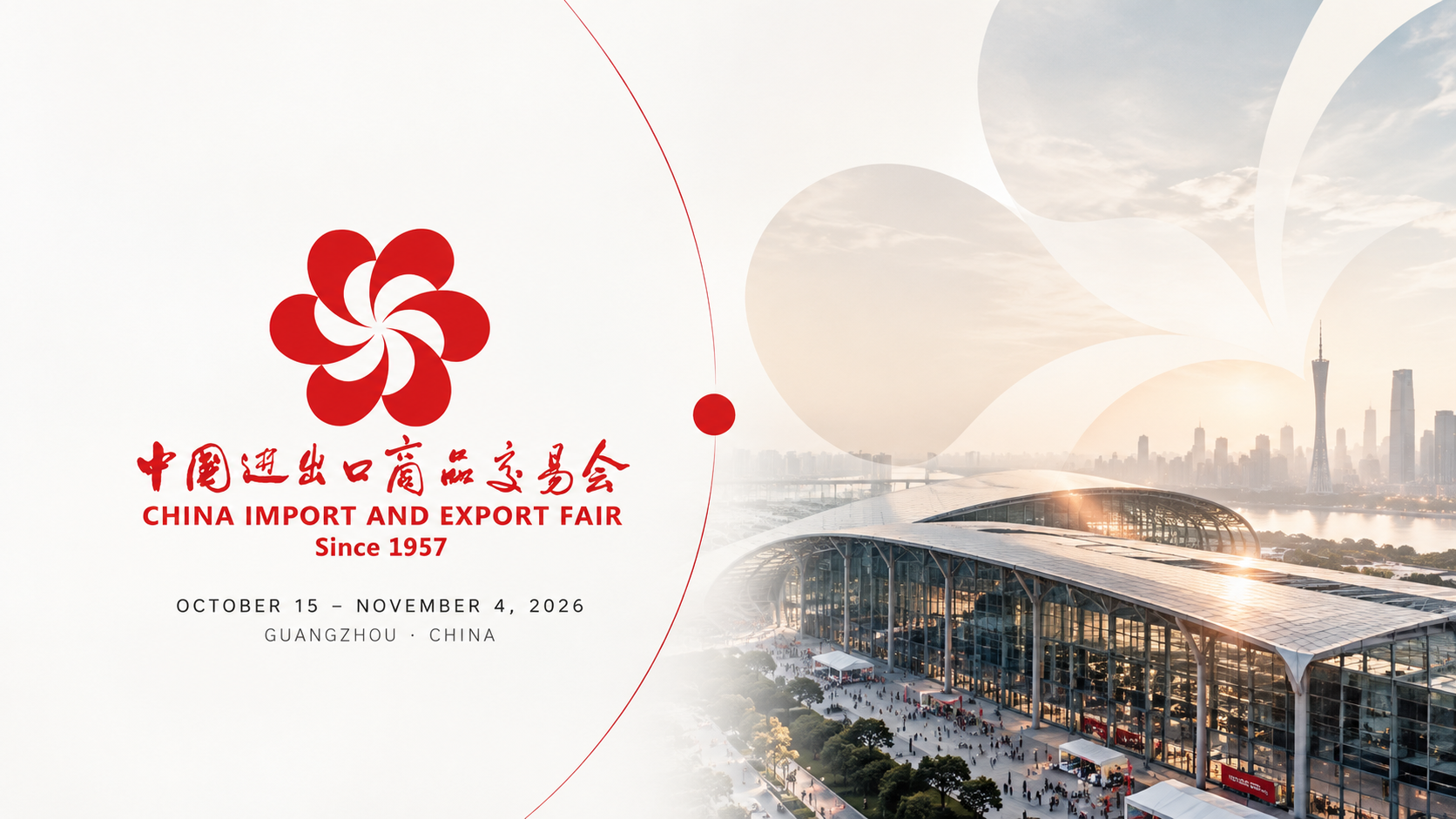
Mindzy will be present at the 140th China Import and Export Fair — Canton Fair — in Guangzhou, taking place across three phases from 15 October to 4 November 2026. Phase 1, from 15–19 October, is dedicated to Advanced Manufacturing. Phase 2 follows from 23–27 October around Quality Home Life, before Phase 3 from 31 October–4 November focuses on Better Life and consumer industries.
The event will cover approximately 1.55 million square meters, with more than 32,000 exhibitors expected. The previous edition welcomed around 314,000 overseas buyers from 220 countries and regions. For Mindzy, the Canton Fair sits directly at the intersection of two realities we work with every day: international companies entering or operating in China, and Chinese companies preparing to operate internationally.
Increasingly, the challenge on both sides is not simply commercial. It is technological.
China and the rest of the world increasingly operate on different technology stacks
A company entering Mainland China quickly discovers that localization means much more than translating a website into Chinese. Software architectures designed for Europe or North America may depend on services, APIs, cloud providers, communication tools or AI platforms that are not available in the same way inside Mainland China.
The same fragmentation can affect cloud services, authentication, communications, maps, payments, data storage and enterprise integrations. The practical question is how to preserve the same product, workflow and operating standard when the underlying digital infrastructure changes.
Technical localization is therefore essential. A Chinese version of an international system should not simply be a translated copy. It may need a different model provider, different integrations, local infrastructure, different data flows and sometimes an entirely different backend architecture — while keeping the experience consistent for the company and its employees. This is one of the areas Mindzy works on through Engineering and Compute.
The opposite problem exists for Chinese companies going overseas
The Canton Fair has historically been one of the world’s most important platforms for Chinese companies to reach international buyers. But today, exporting a product is often only the beginning. A manufacturer selling internationally increasingly needs an entire digital layer around the physical product: CRM systems, international websites, customer portals, multilingual support, AI-assisted sales, quotation systems, product databases, overseas cloud infrastructure, analytics, marketing automation and integrations with global software platforms.
A company may have an excellent factory, a competitive product and sophisticated domestic operations, yet still present itself internationally with a poorly localized website, fragmented sales processes and software that does not match overseas expectations. The opportunity is no longer simply “How do we sell this Chinese product abroad?” It is increasingly “How do we make this Chinese company operate like a global company?”
That requires product engineering, software, AI, infrastructure and localization working together. The Canton Fair’s Trade Services Zone is expanding around R&D and design, digital transformation, business consulting, logistics and international market development — supporting companies throughout the export lifecycle.
China’s AI problem is not necessarily model capability
Restricted access to some American AI products does not mean Chinese users operate with fundamentally weaker technology. China now has an extremely large domestic generative-AI ecosystem, and Chinese-developed model families are increasingly competitive internationally, particularly in open-weight models, coding and agentic workloads.
The more useful question is not only whether China has good AI models. It is whether those models are delivered through products that people actually want to use. The interface, onboarding, workflow design, integrations, reliability, agent experience and overall simplicity of the product can matter as much as model intelligence.
Companies do not use “models”. They use products and workflows powered by models. A sales employee cares whether a system understands the company, connects to the CRM, drafts the right proposal, retrieves the right information and knows when human approval is required. In many cases, the model itself is already powerful enough; what is missing is the system around it.
One product does not need one AI stack
Mindzy does not believe enterprise software must depend permanently on a single AI provider. An international deployment might use one set of models and infrastructure. The same application running in Mainland China may use an entirely different combination of models, compute and integrations. Yet to the employee using the application, the experience can remain almost identical.
This makes it possible to build a consistent software layer while adapting the intelligence and infrastructure underneath it to each market. As technology ecosystems become more politically and commercially fragmented, it is often more effective to build systems capable of operating across both than to force one ecosystem into the other.
China has its own models, cloud providers, platforms and data-governance framework. The United States and Europe operate with another combination of providers and regulatory constraints. The objective is to engineer systems for both realities.
Data architecture, manufacturing and international expansion
Cross-border operations introduce questions around data. Where the database sits, which model processes information, what is transmitted internationally and which systems communicate with one another are no longer purely technical decisions. They become part of international operations. Mindzy’s role is therefore not simply to build software interfaces, but to engineer systems that respect the operational reality of each market.
The Canton Fair also shows how closely manufacturing and artificial intelligence are beginning to converge. Advanced Manufacturing covers industrial automation, intelligent manufacturing, electronics, smart mobility, new energy and machinery. A factory may need computer vision for quality control, predictive maintenance, automated quotation and procurement workflows, engineering knowledge systems, internal AI assistants, local inference, GPU workstations, private servers or AI agents connected to ERP, CRM and production data.
From Made in China to Built for the World, more Chinese companies want to own more of the value chain: the brand, customer relationship, software, data and international distribution channel. AI can translate and localize product information, software can automate quotations, agents can qualify international leads, and private AI infrastructure can bring intelligence directly into factories and engineering departments.
A two-way technology bridge
This is why the Canton Fair is important to Mindzy. For international companies operating in China, we can adapt products, AI systems and infrastructure to the realities of Mainland China. For Chinese companies operating internationally, we can help transform domestic systems into software and products designed for international customers, teams and markets.
For companies operating across both, the objective is to avoid building two disconnected organizations. Instead, we can engineer a common operating layer, with the appropriate models, infrastructure and integrations underneath each market. Engineering builds the software and AI systems. Compute provides the infrastructure required to run them. Coceyo Enterprise provides an AI working environment connected to company context, tools and workflows.
The 140th Canton Fair will bring together thousands of companies already world-class at producing physical products. The next opportunity is helping more of those companies become equally strong at software, artificial intelligence and global digital operations — while helping international companies access the strength of China’s technology ecosystem without sacrificing the product experience they expect elsewhere.
Key takeaways
- Localization in China often requires different architecture, integrations and infrastructure, not only translation.
- Chinese companies expanding internationally need a complete digital layer around their physical products.
- A common software layer can operate with models, data and infrastructure adapted to each market.
Sources
- Primary source · China Import and Export Fair ·
Continue from insight to system
Explore how Mindzy turns this subject into an operational technology decision.
Explore EnterpriseMindzy
Mindzy Letters
A concise briefing on AI systems, enterprise technology and the signals that matter.
For executives, technology leaders and operators.