Mindzy at LEAP East Hong Kong 2026
LEAP East made the accelerating technology relationship between Saudi Arabia, Asia and China visible across AI, compute, infrastructure and investment.
In this article
Why it matters
LEAP East showed AI moving from experimentation into infrastructure and operations while new technology corridors connect Saudi Arabia, Hong Kong and Mainland China.
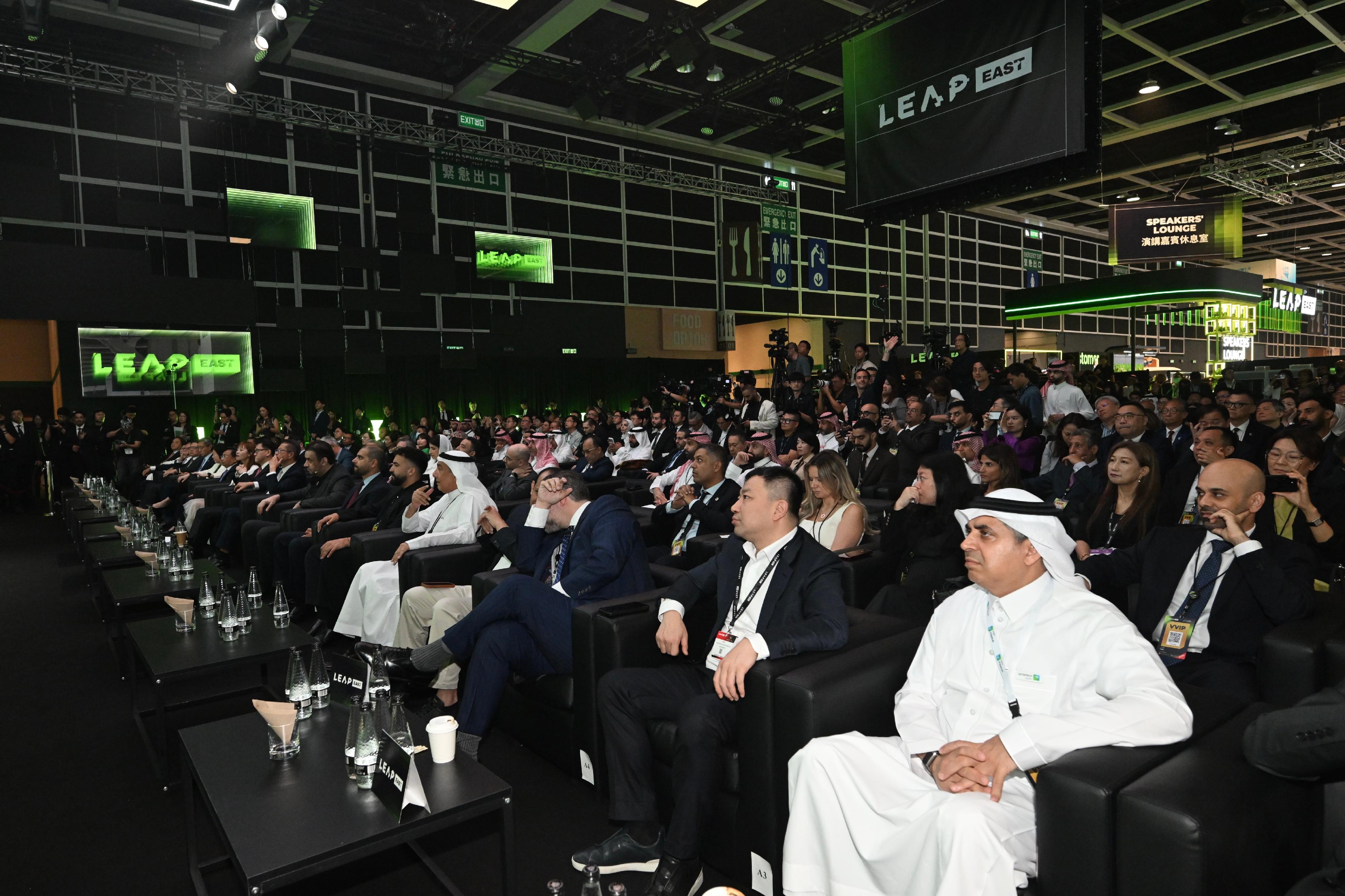
Original source: Hong Kong Government ↗A bridge between Saudi Arabia and Asia
Mindzy attended the inaugural LEAP East in Hong Kong, where the accelerating relationship between Saudi Arabia and Asia — particularly China — was visible across artificial intelligence, infrastructure, investment and advanced technology. From 8 to 10 July 2026, LEAP held its first international edition at the Hong Kong Convention and Exhibition Centre. Born in Riyadh in 2022, the technology event expanded outside Saudi Arabia for the first time, positioning Hong Kong as its entry point into Asia.
Mindzy was present during the three-day event alongside technology companies, investors, startups, policymakers and operators from across the Middle East and Asia. For us, the significance of LEAP East went beyond another technology conference. It illustrated how quickly the geography of the global technology industry is changing.
According to the Hong Kong Government, LEAP East brought together more than 35,000 participants, 340 speakers and 450 exhibitors from 30 countries and regions, and will continue in the city for the next three years. Hong Kong sits at the intersection of international capital, Mainland China’s technology ecosystem and global markets. Around 300 startups and 600 investors participated, with investors collectively representing more than US$6.5 trillion in assets under management, according to the Hong Kong Convention and Exhibition Centre.
Saudi Arabia and China are moving deeper into technology
Saudi Arabia and China have been strengthening cooperation in artificial intelligence, digital infrastructure, cloud computing, robotics, advanced manufacturing, data centers and technology transfer. The timing around LEAP East made this particularly visible.
On 10 July, as LEAP East concluded, Saudi Arabia’s Minister of Communications and Information Technology, Abdullah Alswaha, met Chinese technology companies in Shenzhen. Discussions with Huawei included artificial intelligence, cloud computing, digital infrastructure and skills development. Days later in Beijing, Saudi and Chinese officials discussed expanding cooperation in AI, the digital economy, technology transfer and talent exchange, as well as increasing the presence of Chinese technology companies in Saudi Arabia.
This follows a broader trend. In June, Saudi Arabia’s NHC Innovation signed agreements with Huawei, Lenovo and ByteDance covering artificial intelligence, data science, advanced data centers, smart cities, knowledge transfer and talent development. LEAP East therefore felt less like an isolated event and more like one part of a much larger shift.
AI is becoming an infrastructure industry
A few years ago, much of the AI conversation centered on models: which model was more capable, how large it was, or what a new chatbot could do. That is no longer enough. Companies and governments are increasingly discussing the complete systems required to make AI operational: compute infrastructure, data centers, model deployment, enterprise software, agents, robotics, data, networks, security and energy.
LEAP East’s programme reflected this broader scope, spanning artificial intelligence alongside deep tech, smart cities, robotics, fintech and digital infrastructure. For enterprises, the question is moving from “Which AI model should we use?” toward “How do we integrate AI into an organization, connect it to existing systems, give it access to the right data and provide enough compute to run it reliably?”
For countries, the same transition is happening at a larger scale. AI capability increasingly depends not only on access to models, but on chips, compute capacity, data centers, power, cloud infrastructure, engineering capability and talent. China has developed one of the world’s largest technology and manufacturing ecosystems, while Saudi Arabia is investing heavily in digital and AI capabilities through Vision 2030.
Why LEAP East mattered for Mindzy
For Mindzy, being at LEAP East was valuable because our work sits across several of these layers. We build custom software and AI systems through Mindzy Engineering, provide the compute infrastructure they run on through Mindzy Compute, and develop Coceyo, our enterprise AI environment. Being in Hong Kong provided a direct view into how enterprises, investors and governments are thinking about the next phase of technology deployment.
The strongest signal was clear: AI is moving out of experimentation and into real infrastructure and operations. The companies that matter in the next phase will not simply demonstrate what AI can do. They will have to make it work inside real organizations — connected to existing software, company data, workflows, permissions and physical compute infrastructure.
At the same time, the technology map itself is becoming more multipolar. The growing relationship between Saudi Arabia, Hong Kong and Mainland China illustrates how new technology corridors are emerging between regions previously connected primarily through trade, finance and energy. Today, those relationships increasingly include AI, compute, data centers, advanced manufacturing, robotics and software infrastructure.
Key takeaways
- LEAP East placed Hong Kong at the meeting point of Saudi, Chinese and Asian technology ecosystems.
- AI is now discussed as a full stack of infrastructure, data, energy, software and operations.
- Mindzy operates across this stack through Engineering, Compute and Coceyo Enterprise.
Sources
- Primary source · Hong Kong Government ·
- LEAP East — Event FAQ
Continue from insight to system
Explore how Mindzy turns this subject into an operational technology decision.
Explore ComputeMindzy
Mindzy Letters
A concise briefing on AI systems, enterprise technology and the signals that matter.
For executives, technology leaders and operators.