The Enterprise AI Stack
A practical guide to software, AI systems and compute for organizations deploying artificial intelligence at scale.
A decision framework for leaders who need to connect business workflows, software, models, governance and infrastructure without creating a fragile collection of pilots.
A Mindzy editorial publication · Published October 1, 2026
- Audience
- CEO · CTO · CIO · COO
- Business need
- AI Leadership
- Technical topics
- Enterprise · AI Systems · Software · Compute
Inside the guide
- 01
Start with the operating model
Enterprise AI begins with the work: decisions, handoffs, approvals, exceptions and the systems of record behind them. This chapter shows how to map workflows before selecting models or platforms.
- Name the business owner and the measurable outcome.
- Map the current workflow, including exceptions.
- Separate automation candidates from judgment-heavy decisions.
- 02
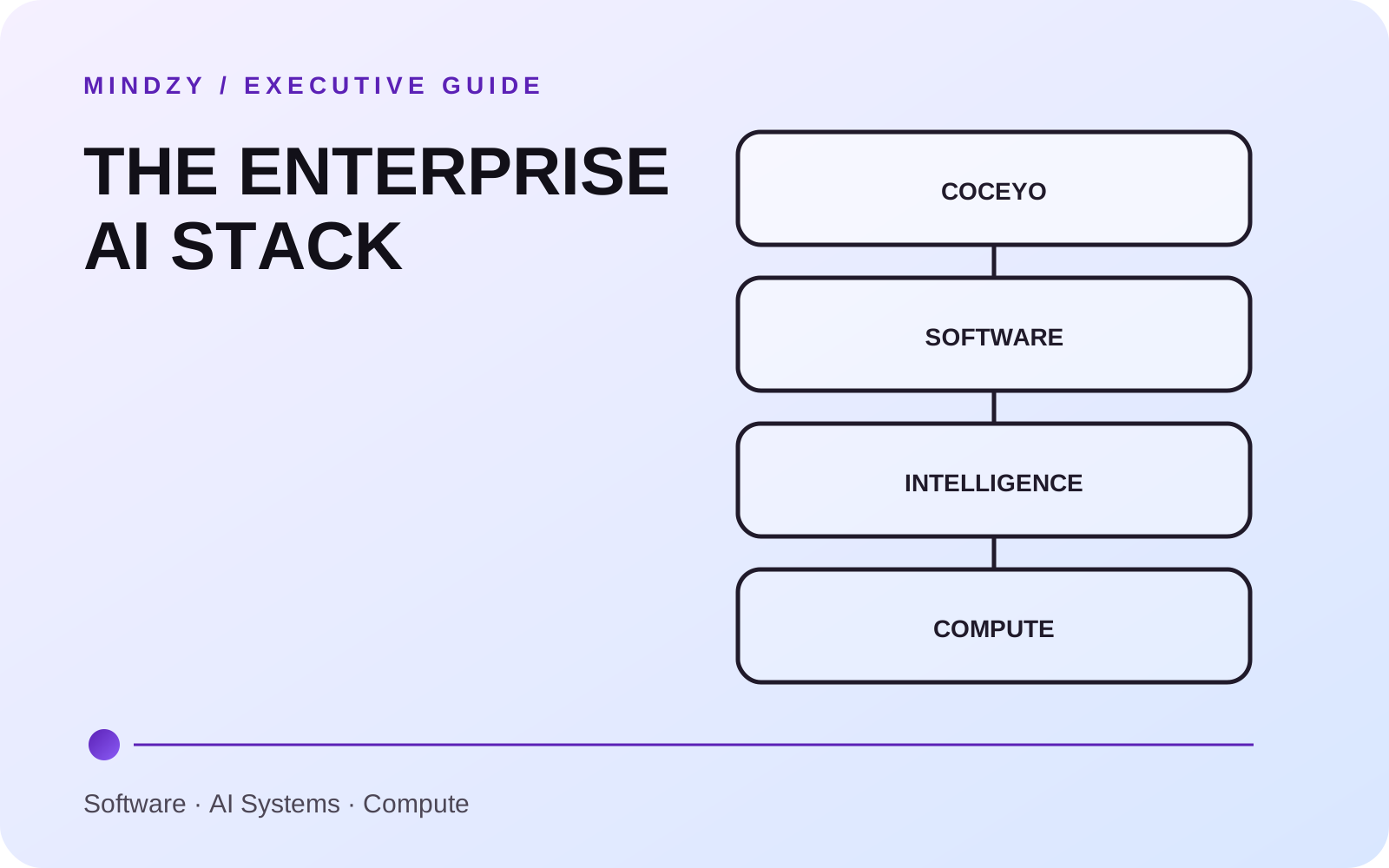
The four layers of the enterprise AI stack
A durable architecture separates the interface, operational software, intelligence layer and compute. The separation makes each layer replaceable while preserving contracts, permissions and observability.
- Define stable interfaces between layers.
- Avoid binding workflow logic to one model vendor.
- Treat compute as an architectural choice, not a procurement afterthought.
- 03
Company context and knowledge
Models become useful when they can retrieve the right company knowledge with provenance, freshness and permission boundaries. This chapter covers source ownership, indexing, retrieval and citation requirements.
- Assign an owner to every knowledge source.
- Carry document permissions into retrieval.
- Measure retrieval quality separately from answer quality.
- 04
Agents, tools and workflow execution
An agent is an execution system, not a chat window. Reliable deployments constrain tools, validate arguments, record actions and define where human approval is mandatory.
- Use narrow tools with explicit schemas.
- Require approval for irreversible actions.
- Log the full path from request to tool result.
- 05
Model routing and resilience
Different tasks require different combinations of accuracy, latency, privacy and cost. A model gateway creates routing, fallback and evaluation policies without rewriting every application.
- Route by task and risk, not model popularity.
- Design provider failover before production.
- Keep evaluation sets tied to real workflows.
- 06
Identity, permissions and governance
Enterprise AI must inherit organizational identity, role boundaries and audit requirements. Governance works best when it is implemented in the execution path rather than added as a review document.
- Apply least privilege to agents and users.
- Record policy decisions and approvals.
- Maintain an inventory of AI systems and accountable owners.
- 07
Observability and evaluation
Production quality cannot be reduced to a single success rate. Teams need traces, cost and latency telemetry, failure taxonomies, consistency checks and business-level outcome metrics.
- Trace model, retrieval and tool calls together.
- Review failure classes, not only averages.
- Connect technical metrics to operational outcomes.
- 08
Compute choices and deployment patterns
Cloud, hybrid and private infrastructure each solve different constraints. The correct choice follows workload shape, data sensitivity, latency, utilization and the organization’s ability to operate the platform.
- Profile workload before sizing infrastructure.
- Include networking, storage and operations in total cost.
- Preserve portability where it matters.
- 09
A phased deployment roadmap
The strongest programs move from diagnosis to one bounded production workflow, then scale shared capabilities. This chapter defines gates for evidence, security, adoption and operational readiness.
- Prove one workflow end to end.
- Build shared controls only when the first use case needs them.
- Scale by reusable capability, not by demo count.
- 10
Executive decision checklist
A concise checklist for investment committees and leadership teams: value, ownership, architecture, risk, data, change management, operating model and exit conditions.
- Demand a named owner and baseline.
- Make rollback and vendor exit explicit.
- Fund operations and adoption, not only build work.
Download coming soon