The Private AI Playbook
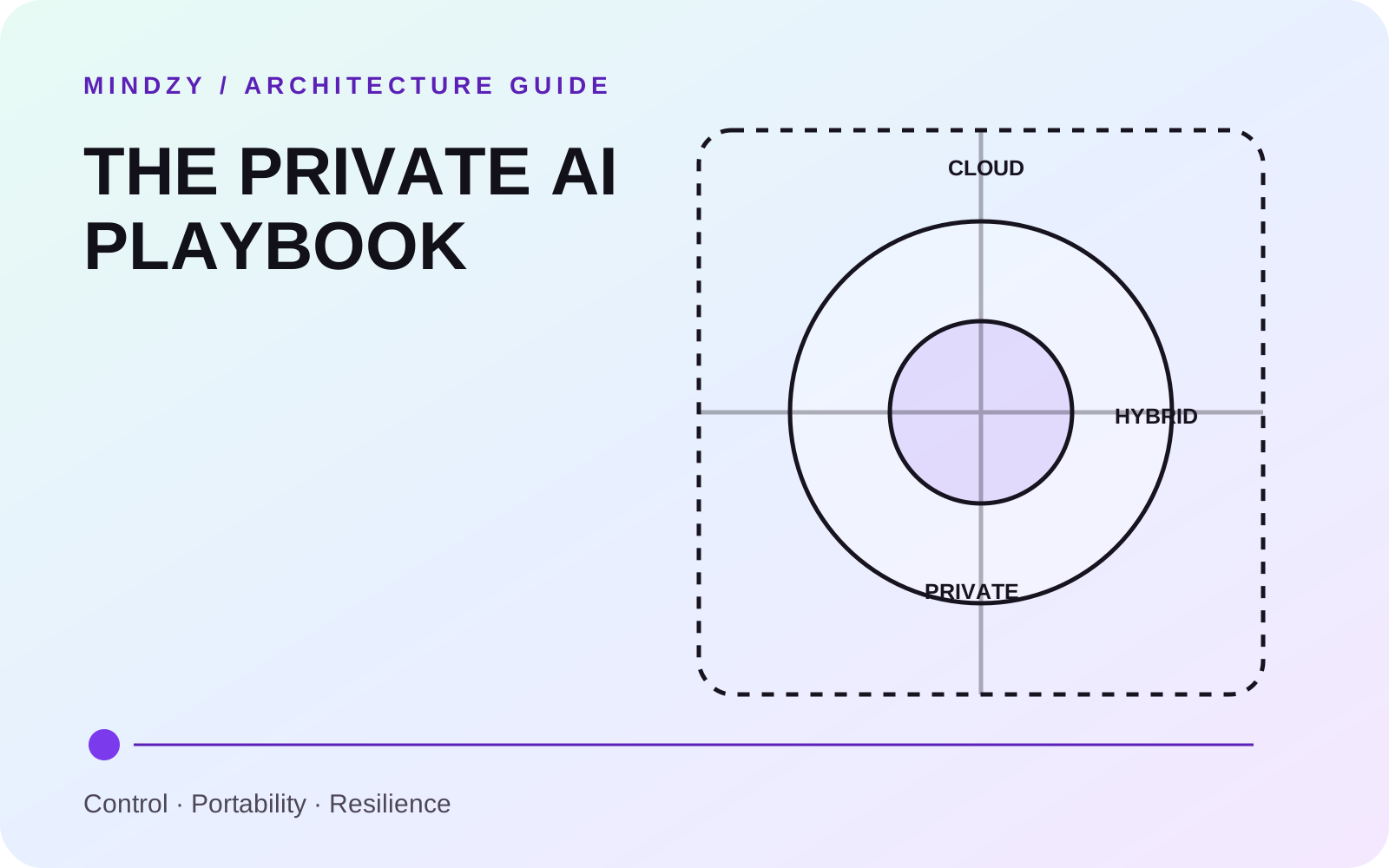
When cloud, hybrid and on-premise AI make sense — and how to choose the right architecture.
A practical architecture and governance playbook for leaders deciding where models, data and AI workloads should run.
A Mindzy editorial publication · Published October 1, 2026
- Audience
- CTO · CIO · CISO · COO
- Business need
- Data & Security
- Technical topics
- Compute · Private AI · Enterprise · AI Systems
Inside the guide
- 01
Define private AI precisely
Private AI is not a single product. It is a set of controls over where data, models, logs and execution live, who can access them, and how providers are allowed to retain or process information.
- Document the required control boundary.
- Separate privacy claims from deployment facts.
- Classify data before choosing infrastructure.
- 02
Classify workloads before platforms
Workloads differ by sensitivity, latency, throughput, model size and failure tolerance. A workload inventory prevents every use case from inheriting the cost and complexity of the strictest one.
- Group workloads by control and performance needs.
- Identify bursty versus steady demand.
- Record retention and residency constraints.
- 03
Cloud: speed and elasticity
Cloud services are often the fastest path to experiments and variable workloads. The design challenge is to control identity, network paths, data handling, logging and provider dependencies.
- Use private connectivity where justified.
- Set explicit data retention policies.
- Model egress, managed-service and lock-in costs.
- 04
Hybrid: place each workload deliberately
Hybrid AI keeps selected data or inference inside a controlled environment while using cloud capacity or managed models elsewhere. It succeeds only with clear contracts, routing and observability across boundaries.
- Keep routing policy visible and testable.
- Design for degraded connectivity.
- Unify identity and audit events across environments.
- 05
On-premise: control with operational responsibility
Private infrastructure can improve control, predictable latency and workload economics, but transfers capacity planning, patching, security and availability to the organization.
- Budget people and lifecycle management.
- Plan spare capacity and failure domains.
- Validate that utilization can justify ownership.
- 06
Security architecture for AI workloads
AI systems expand the attack surface through prompts, retrieval sources, model endpoints and tools. Defense requires least privilege, segmentation, validation, monitoring and incident response designed around the complete execution chain.
- Threat-model retrieval and tool access.
- Protect secrets outside prompts and traces.
- Test abuse cases before production.
- 07
Hardware, storage and networking
Accelerators are only one part of the system. Memory capacity, interconnects, storage throughput, model loading, vector search and network topology can become the actual constraint.
- Benchmark representative end-to-end workloads.
- Size memory before counting accelerators.
- Include storage and network telemetry in capacity plans.
- 08
Economics and total cost of ownership
A credible comparison includes utilization, financing, power, cooling, space, networking, software, support and engineering time. Unit economics should be calculated per business workload, not only per GPU hour.
- Compare equivalent service levels.
- Use realistic utilization ranges.
- Price the cost of idle capacity and migration.
- 09
Portability and exit design
Organizations need a practical exit path from providers, models and hardware generations. Portability comes from controlled interfaces, open data formats, reproducible evaluations and documented operational procedures.
- Keep prompts, policies and evaluations portable.
- Test a secondary path periodically.
- Contract for data export and deletion evidence.
- 10
Architecture decision matrix
A final decision matrix aligns confidentiality, residency, latency, scale, utilization, model choice, operational maturity and recovery requirements to cloud, hybrid or private deployment patterns.
- Choose per workload, not per ideology.
- Document assumptions and review dates.
- Start reversible and increase commitment with evidence.
Download coming soon